
The lesson
Read each section in order, work through every example on paper, then use the practice problems and quick check at the bottom.
Comparing with ratios
A ratio compares two amounts. If a recipe uses 2 cups of flour and 3 cups of sugar, the ratio of flour to sugar is 2 to 3 - written 2:3 or 2/3.
A ratio compares two quantities with the same units. Order matters: a ratio of cats to dogs is not the same as dogs to cats unless the problem says they are equivalent.
Write ratios in three ways: with a colon (3:4), as a phrase (3 to 4), or as a fraction (3/4) when it fits the context.
Order matters
Flour to sugar (2:3) is not the same as sugar to flour (3:2). Always write the parts in the order the problem names them.
Equivalent ratios
Multiply or divide both parts of a ratio by the same number to get an equivalent ratio that describes the same comparison.
Are 2:3 and 8:12 equivalent?
- 1Multiply both parts of 2:3 by 4.
- 22 × 4 = 8 and 3 × 4 = 12, so 2:3 → 8:12.
- 3Yes - they are equivalent.
Why this matters
Compare two quantities - and find ratios that mean the same thing.
These ideas show up on homework, quizzes, and the next unit in this grade. Getting comfortable here saves time later when the problems stack more steps together.
Common mistakes to avoid
Reversing the order named in the problem. Write the ratio in the same order the words give you.
Treating a part-to-part ratio like a part-to-whole fraction without checking what the whole is.
Key ideas from this lesson
- Comparing with ratios
- Order matters
- Equivalent ratios
Video walkthroughs
Ratios & Rates
What a ratio is and how it shows up in everyday comparisons.
Watch on YouTube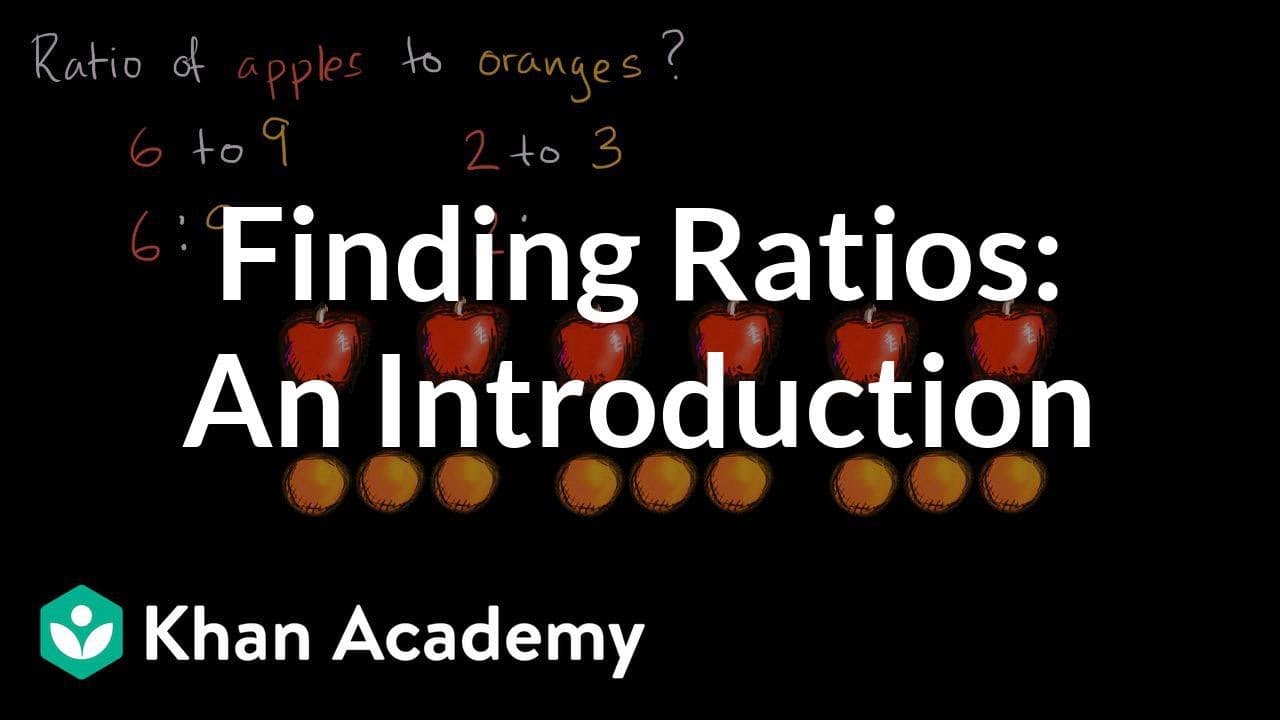
Introduction to Ratios
Another walkthrough of writing a ratio to compare two quantities.
Watch on YouTube
Solving Ratio Problems with Tables
Use ratio tables to find equivalent ratios in context.
Watch on YouTube
Solving a Proportion
Set two equal ratios and solve for an unknown value.
Watch on YouTubePractice
For each problem: write your work in the box, type your answer, and check it. If you are stuck, reveal the solution one step at a time. Do not skip straight to the final answer.
Exercise 1
Try it yourselfA class has 12 boys and 15 girls. Write the ratio of boys to girls.
Step-by-step solution
- 1Boys : girls = 12 : 15.
- 2You can also write 12/15, which simplifies to 4/5.
Exercise 2
Try it yourselfAre the ratios 3:5 and 12:20 equivalent?
Step-by-step solution
- 1Multiply 3:5 by 4: 3 × 4 = 12 and 5 × 4 = 20.
- 212:20 matches, so they are equivalent.
Exercise 3
Try it yourselfSimplify the ratio 18:24 to lowest terms.
Step-by-step solution
- 1Find the GCF of 18 and 24, which is 6.
- 2Divide both parts by 6: 18 ÷ 6 = 3 and 24 ÷ 6 = 4.
- 3The simplified ratio is 3:4.
Exercise 4
Try it yourselfA paint mix uses 2 parts blue to 5 parts white. How much blue do you need for 15 parts white?
Step-by-step solution
- 12/5 = x/15. Cross-multiply: 5x = 30.
- 2x = 6 parts blue.
Exercise 5
Try it yourselfThe ratio of red marbles to blue marbles is 7:3. There are 35 red marbles. How many blue marbles are there?
Step-by-step solution
- 17 parts red correspond to 35 marbles, so 1 part = 35 ÷ 7 = 5.
- 2Blue has 3 parts: 3 × 5 = 15 blue marbles.
Quick check
Answer all questions. Retake the quiz until you feel confident before moving on.
What Is a Ratio?
Question 1 of 5
Write the ratio of 5 dogs to 8 cats.