
The lesson
Read each section in order, work through every example on paper, then use the practice problems and quick check at the bottom.
What makes a relationship proportional
Two quantities are proportional when they always change by the same rate. If you earn $12 every hour, dollars and hours are proportional - the rate stays 12 no matter how many hours you work.
Solving a proportion
Set two equal ratios next to each other and cross-multiply to find the missing value.
Solve 3/5 = x/20
- 1Cross-multiply: 3 × 20 = 5 × x.
- 260 = 5x.
- 3Divide by 5: x = 12.
Why this matters
Two quantities that grow together at one steady rate.
These ideas show up on homework, quizzes, and the next unit in this grade. Getting comfortable here saves time later when the problems stack more steps together.
Common mistakes to avoid
Reversing the order named in the problem. Write the ratio in the same order the words give you.
Treating a part-to-part ratio like a part-to-whole fraction without checking what the whole is.
Key ideas from this lesson
- What makes a relationship proportional
- Solving a proportion
Video walkthroughs
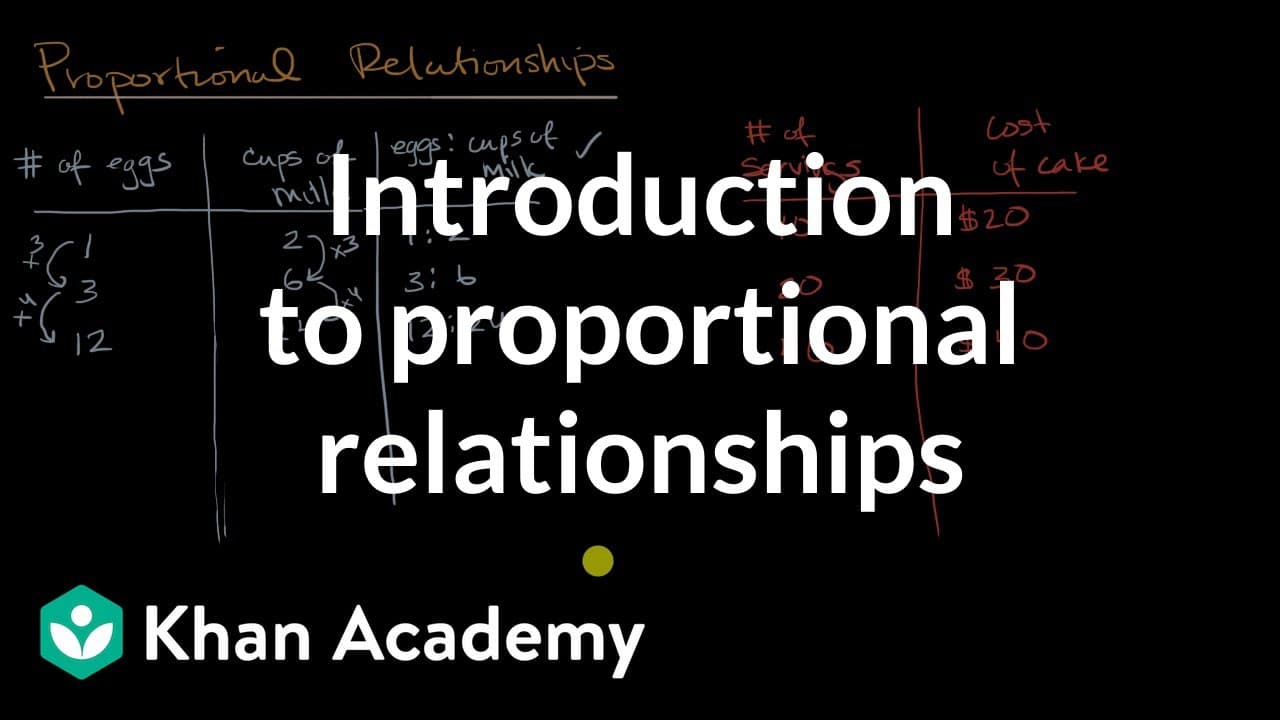
Proportional Relationships
Spot when two quantities grow together at a steady rate.
Watch on YouTube
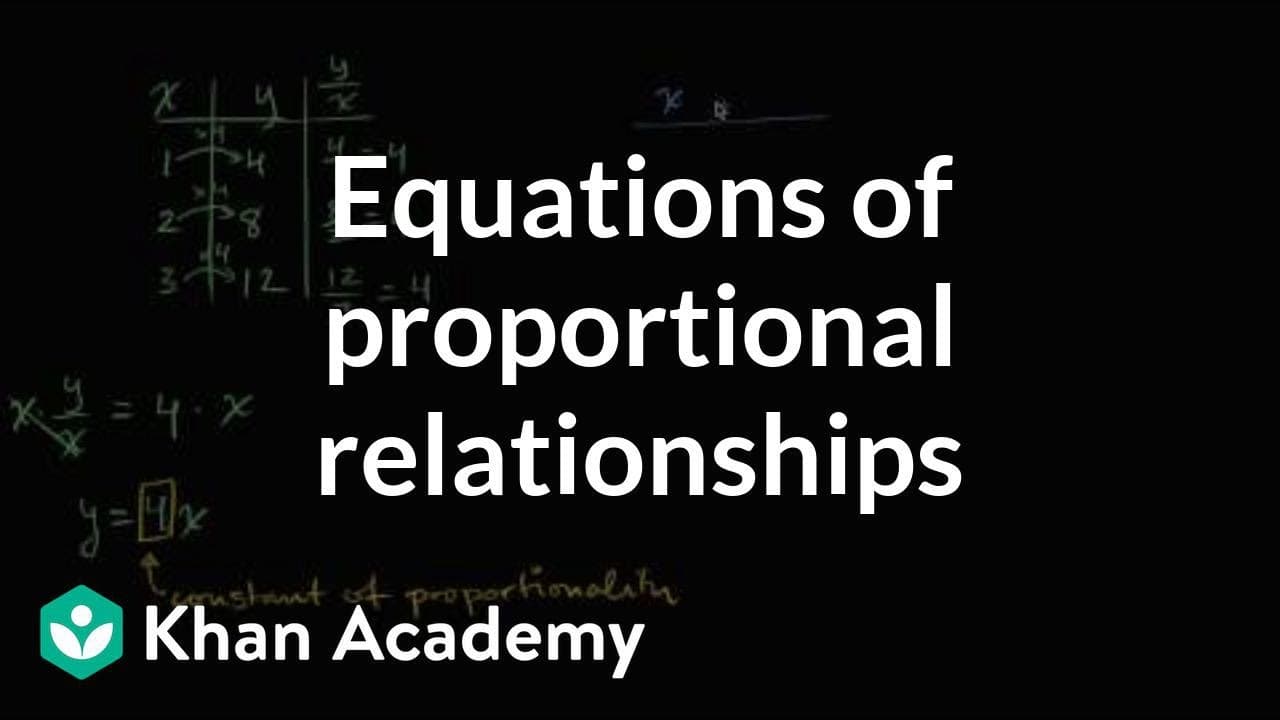
Equations of Proportional Relationships
Write y = kx and identify the constant of proportionality.
Watch on YouTube
Solving a Proportion
Cross-multiply to solve real-world proportion problems.
Watch on YouTubePractice
For each problem: write your work in the box, type your answer, and check it. If you are stuck, reveal the solution one step at a time. Do not skip straight to the final answer.
Exercise 1
Try it yourselfSolve the proportion: 2/7 = x/21.
Step-by-step solution
- 12 × 21 = 7 × x → 42 = 7x.
- 2Divide by 7: x = 6.
Exercise 2
Try it yourselfIf 4 pencils cost $3, how much do 10 pencils cost?
Step-by-step solution
- 1Unit price: $3 ÷ 4 = $0.75 per pencil.
- 210 × $0.75 = $7.50.
Exercise 3
Try it yourselfA map scale is 1 inch = 15 miles. Two towns are 4.5 inches apart on the map. How many miles apart are they?
Step-by-step solution
- 1Multiply: 4.5 × 15 = 67.5 miles.
Exercise 4
Try it yourselfSolve: 5/8 = 15/x.
Step-by-step solution
- 1Cross-multiply: 5x = 8 × 15 = 120.
- 2x = 120 ÷ 5 = 24.
Exercise 5
Try it yourselfA recipe for 6 servings uses 2 cups of rice. How many cups are needed for 15 servings?
Step-by-step solution
- 1Set up 2/6 = x/15. Cross-multiply: 6x = 30.
- 2x = 5 cups of rice.
Quick check
Answer all questions. Retake the quiz until you feel confident before moving on.
Proportional Relationships
Question 1 of 5
If 5 notebooks cost $7.50, how much do 8 notebooks cost?