
The lesson
Read each section in order, work through every example on paper, then use the practice problems and quick check at the bottom.
The volume formula still works
Volume of a rectangular prism is always length × width × height. When edges are mixed numbers, turn each into an improper fraction (or a decimal) first, then multiply.
Volume measures space inside a 3D object, in cubic units. Think of how many unit cubes would fill the shape.
For prisms, volume is often (area of the base) × (height). The base and height must be perpendicular for that shortcut.
Find the volume of a box that is 1½ ft × 2 ft × 4 ft.
- 1Write 1½ as 1.5 (or 3/2).
- 21.5 × 2 × 4 = 12.
- 3Volume = 12 cubic feet.
Why this matters
Same length × width × height - even when the edges are fractions.
These ideas show up on homework, quizzes, and the next unit in this grade. Getting comfortable here saves time later when the problems stack more steps together.
Common mistakes to avoid
Adding numerators and denominators separately (2/3 + 1/4 is not 3/7). Match denominators first, or use a clear model.
Forgetting to simplify the final answer when a smaller equivalent fraction is possible.
Key ideas from this lesson
- The volume formula still works
Video walkthroughs

Volume of Rectangular Prisms
Length × width × height for box-shaped objects.
Watch on YouTube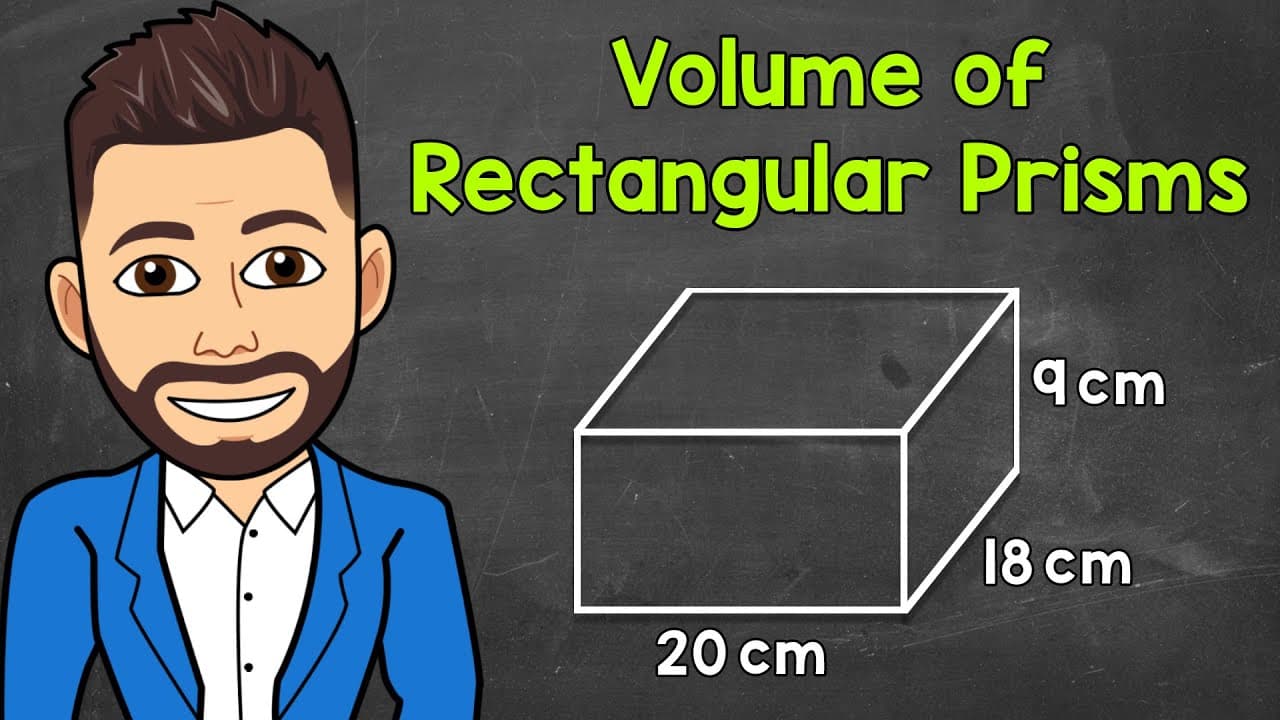
Practice
For each problem: write your work in the box, type your answer, and check it. If you are stuck, reveal the solution one step at a time. Do not skip straight to the final answer.
Exercise 1
Try it yourselfFind the volume of a box 2 ft × 3 ft × 5 ft.
Step-by-step solution
- 1V = 2 × 3 × 5 = 30 ft³.
Exercise 2
Try it yourselfFind the volume of a prism 1½ in × 4 in × 2 in.
Step-by-step solution
- 11.5 × 4 × 2 = 12 in³.
Exercise 3
Try it yourselfA fish tank is 2½ ft long, 1 ft wide, and 1½ ft tall. How many cubic feet of water does it hold?
Step-by-step solution
- 12.5 × 1 × 1.5 = 3.75 ft³.
Exercise 4
Try it yourselfA prism has volume 45 m³. The base is 7½ m². Find the height.
Step-by-step solution
- 145 = 7.5 × h.
- 2h = 45 ÷ 7.5 = 6 m.
Exercise 5
Try it yourselfA storage crate is 3¼ ft × 2 ft × 1⅖ ft. Round to the nearest tenth and find the volume in cubic feet.
Step-by-step solution
- 13.25 × 2 × 1.4 = 9.1 ft³ (nearest tenth).
Worksheet - Applied geometry
End-of-year mixed practice across area, surface area, and volume.
Quick check
Answer all questions. Retake the quiz until you feel confident before moving on.
Volume with Fractions
Question 1 of 5
A box has dimensions 2 ft × 3 ft × 5 ft. What is its volume?