
The lesson
Read each section in order, work through every example on paper, then use the practice problems and quick check at the bottom.
Range
Range is the simplest measure of spread: the largest value minus the smallest value. It's quick, but a single extreme value can stretch it a lot.
Find the range of 2, 5, 7, 8, 11, 14, 20.
- 1Largest − smallest.
- 220 − 2 = 18.
Interquartile range (IQR)
IQR measures the spread of the middle 50% of the data. Because it ignores the extreme high and low values, it is less affected by outliers than the range.
Why this matters
Two ways to measure how spread out a data set is.
These ideas show up on homework, quizzes, and the next unit in this grade. Getting comfortable here saves time later when the problems stack more steps together.
Common mistakes to avoid
Rushing to the answer without writing steps. Clear work helps you catch mistakes and shows your reasoning.
Re-reading the question too quickly. Underline what you are solving for before you start calculating.
Key ideas from this lesson
- Range
- Interquartile range (IQR)
Video walkthroughs
Range and Interquartile Range
Compare the full spread vs. the middle 50%.
Watch on YouTube
Interquartile Range (IQR)
Measure the spread of the middle half of your data.
Watch on YouTube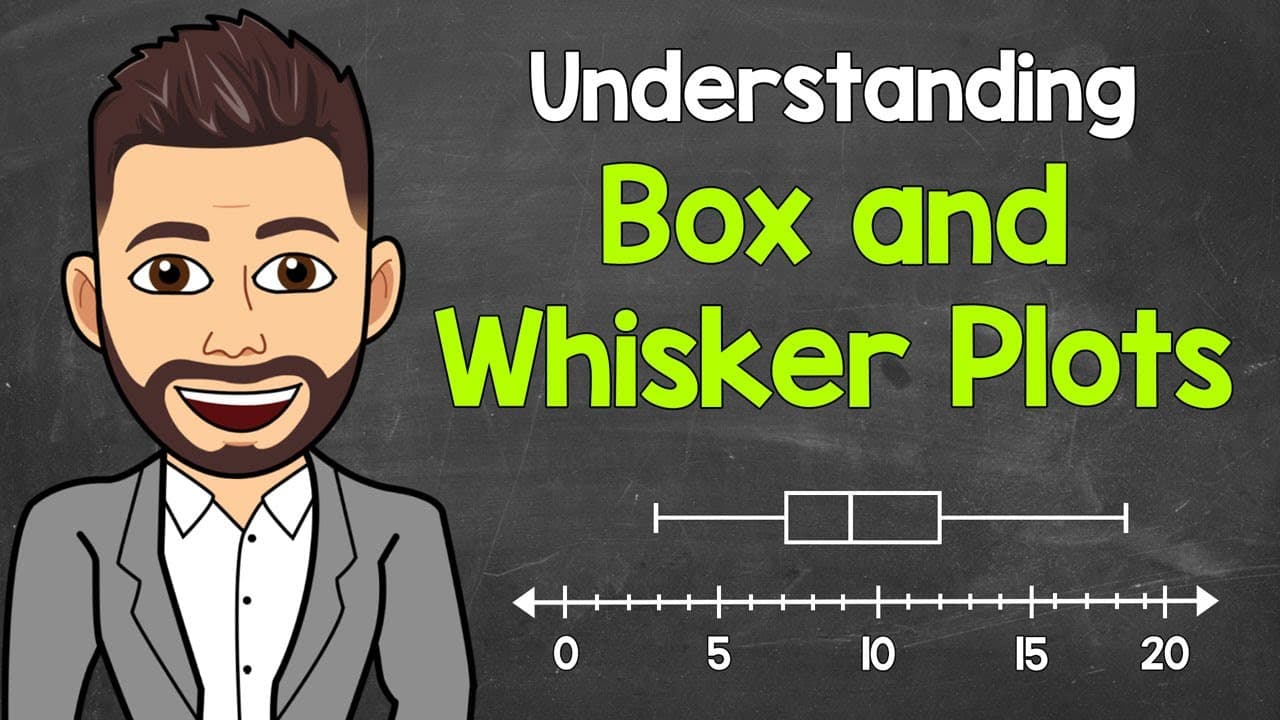
Box and Whisker Plots
Summarize spread using five key values on a box plot.
Watch on YouTube
Practice
For each problem: write your work in the box, type your answer, and check it. If you are stuck, reveal the solution one step at a time. Do not skip straight to the final answer.
Exercise 1
Try it yourselfFind the range of: 15, 22, 18, 30, 12.
Step-by-step solution
- 1Maximum − minimum = 30 − 12.
- 2Range = 18.
Exercise 2
Try it yourselfData set: 4, 8, 10, 12, 16, 20. Find the range.
Step-by-step solution
- 120 − 4 = 16.
Exercise 3
Try it yourselfFor the data 3, 5, 7, 9, 11, 13, 15, the median is 9. What percent of the data lies between the minimum and median?
Step-by-step solution
- 1Values below 9: 3, 5, 7 → 3 out of 7 values.
- 2About 3/7 of the data is below the median (roughly the lower half).
Exercise 4
Try it yourselfTwo data sets both have range 20. Set A: 10–30. Set B: 0–20 with one value 50. Which range is more misleading?
Step-by-step solution
- 1Set B has an outlier at 50 that stretches the range.
- 2IQR would describe Set B's middle better than range.
Exercise 5
Try it yourselfA data set has Q1 = 12, Q3 = 20. Find the IQR.
Step-by-step solution
- 1IQR = Q3 − Q1.
- 2IQR = 20 − 12 = 8.
Quick check
Answer all questions. Retake the quiz until you feel confident before moving on.
Spread: Range & IQR
Question 1 of 5
Find the range of 2, 5, 7, 8, 11, 14, 20.