
The lesson
Read each section in order, work through every example on paper, then use the practice problems and quick check at the bottom.
Factors and multiples
A factor is a number that divides evenly into another number, leaving no remainder. The factors of 12 are 1, 2, 3, 4, 6, and 12, because each one divides 12 exactly.
A multiple is what you get when you skip-count by a number. The multiples of 4 are 4, 8, 12, 16, 20, and so on. Notice that every number is a factor of its own multiples.
A quick way to test factors: divide the number by each candidate. If the quotient is a whole number with no remainder, you found a factor.
Every whole number has at least two factors: 1 and itself. Prime numbers have exactly those two, which is why primes are the building blocks for bigger numbers.
Greatest Common Factor (GCF)
The GCF of two numbers is the largest factor they share. List the factors of each number, then pick the biggest one that appears in both lists.
GCF is useful when you need the largest equal-sized groups you can make from two quantities. Example: 18 pencils and 24 erasers shared into identical kits with nothing left over. The kit size is the GCF.
Another use: simplifying fractions. The GCF of the numerator and denominator is the biggest number you can divide both by at once.
Find the GCF of 18 and 24.
- 1Factors of 18: 1, 2, 3, 6, 9, 18
- 2Factors of 24: 1, 2, 3, 4, 6, 8, 12, 24
- 3Shared factors: 1, 2, 3, 6 - the greatest is 6.
Least Common Multiple (LCM)
The LCM is the smallest multiple that two numbers share. Skip-count by each number until you reach the first value they both land on.
LCM answers questions like: "When will both buses arrive at the same time again?" or "What is the smallest batch size that works for two different recipes?"
If two denominators are different, the LCM of those denominators is often the least common denominator you need for adding fractions.
Find the LCM of 6 and 8.
- 1Multiples of 6: 6, 12, 18, 24, 30…
- 2Multiples of 8: 8, 16, 24, 32…
- 3First match: 24.
Why this matters
Numbers that divide evenly, numbers you count by, and the values they share.
These ideas show up on homework, quizzes, and the next unit in this grade. Getting comfortable here saves time later when the problems stack more steps together.
Common mistakes to avoid
Picking GCF when the problem asks for LCM, or the other way around. Check whether you need the biggest shared factor or the next time both counts line up.
Assuming the LCM is always the product of the two numbers. That only works when the numbers share no factors besides 1.
Skipping 1 when you list factors. Every whole number has 1 as a factor.
Key ideas from this lesson
- Factors and multiples
- Greatest Common Factor (GCF)
- Least Common Multiple (LCM)
Video walkthroughs

Prime Factorization
Break any number into its prime building blocks - the key to GCF and LCM.
Watch on YouTube
GCF: Greatest Common Factor
Find the greatest factor two numbers share in common.
Watch on YouTube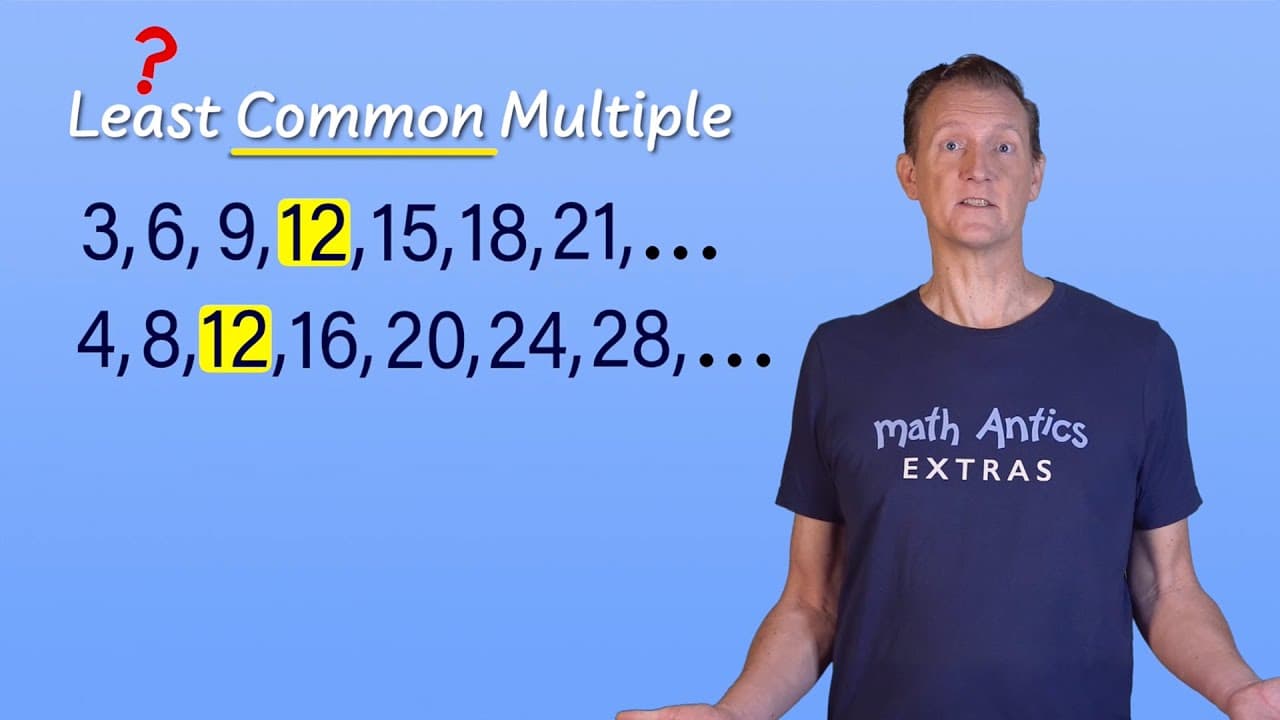
LCM: Basic Method
List multiples to find the least common multiple of two numbers.
Watch on YouTube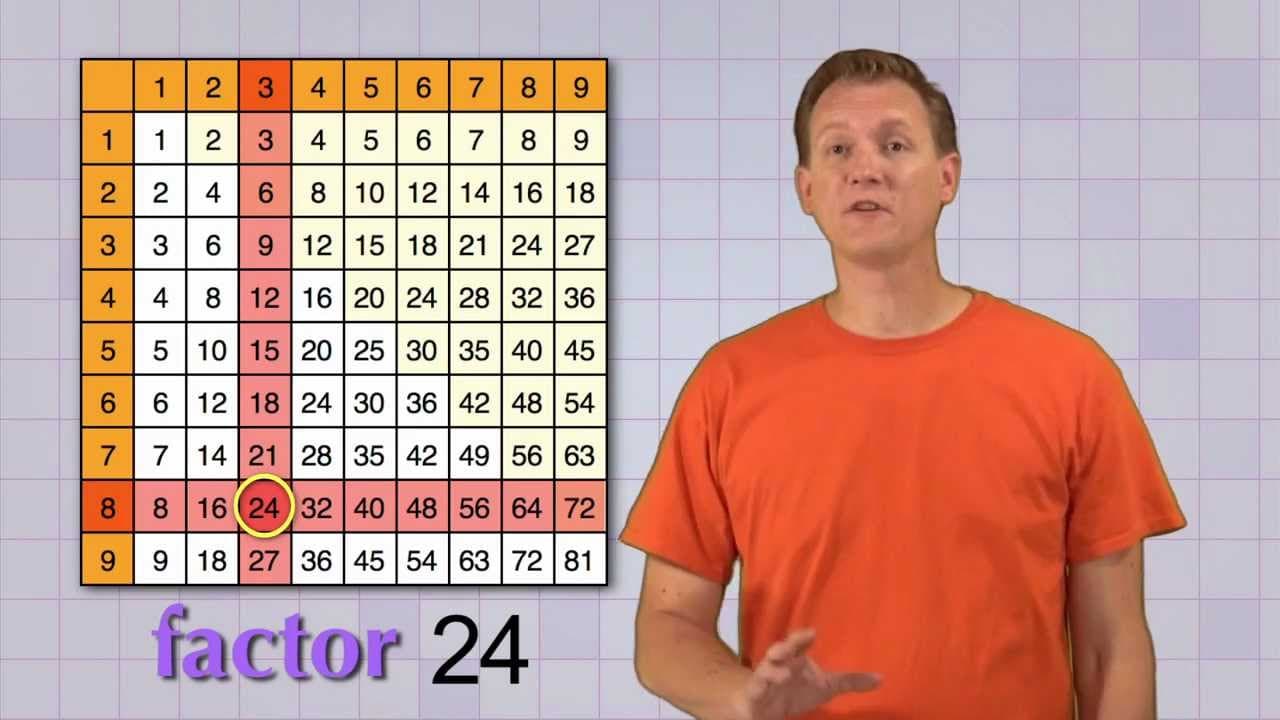
Practice
For each problem: write your work in the box, type your answer, and check it. If you are stuck, reveal the solution one step at a time. Do not skip straight to the final answer.
Exercise 1
Try it yourselfList all the factors of 24.
Step-by-step solution
- 1Test divisors starting at 1: 24 ÷ 1 = 24, 24 ÷ 2 = 12, 24 ÷ 3 = 8, 24 ÷ 4 = 6.
- 2Also 24 ÷ 6 = 4, 24 ÷ 8 = 3, 24 ÷ 12 = 2, 24 ÷ 24 = 1.
- 3The factors are 1, 2, 3, 4, 6, 8, 12, and 24.
Exercise 2
Try it yourselfWhat is the GCF of 30 and 45?
Step-by-step solution
- 1Factors of 30: 1, 2, 3, 5, 6, 10, 15, 30.
- 2Factors of 45: 1, 3, 5, 9, 15, 45.
- 3Shared factors: 1, 3, 5, 15. The greatest is 15.
Exercise 3
Try it yourselfWhat is the LCM of 9 and 12?
Step-by-step solution
- 1Multiples of 9: 9, 18, 27, 36, 45…
- 2Multiples of 12: 12, 24, 36, 48…
- 3The first number in both lists is 36.
Exercise 4
Try it yourselfFind the GCF of 48 and 72 using prime factorization.
Step-by-step solution
- 148 = 2⁴ × 3 and 72 = 2³ × 3².
- 2Common primes: 2 and 3. Use 2³ and 3¹.
- 3GCF = 2³ × 3 = 8 × 3 = 24.
Exercise 5
Try it yourselfTwo buses leave a station at the same time. Bus A returns every 8 minutes and Bus B every 12 minutes. After how many minutes will they both be at the station again at the same time?
Step-by-step solution
- 1Multiples of 8: 8, 16, 24, 32…
- 2Multiples of 12: 12, 24, 36…
- 3LCM(8, 12) = 24 minutes.
Quick check
Answer all questions. Retake the quiz until you feel confident before moving on.
Factors, Multiples, GCF & LCM
Question 1 of 5
What is the GCF of 18 and 24?