
The lesson
Read each section in order, work through every example on paper, then use the practice problems and quick check at the bottom.
The probability scale
Probability runs from 0 (impossible) to 1 (certain). One-half means an event is just as likely to happen as not.
Calculating probability
For equally likely outcomes, probability = (number of favorable outcomes) ÷ (total number of outcomes).
A bag has 3 red and 5 blue marbles. What is the probability of drawing red?
- 1Favorable outcomes (red) = 3.
- 2Total outcomes = 3 + 5 = 8.
- 3Probability = 3/8.
Why this matters
Find how likely a single event is on a 0-to-1 scale.
These ideas show up on homework, quizzes, and the next unit in this grade. Getting comfortable here saves time later when the problems stack more steps together.
Common mistakes to avoid
Rushing to the answer without writing steps. Clear work helps you catch mistakes and shows your reasoning.
Re-reading the question too quickly. Underline what you are solving for before you start calculating.
Key ideas from this lesson
- The probability scale
- Calculating probability
Video walkthroughs
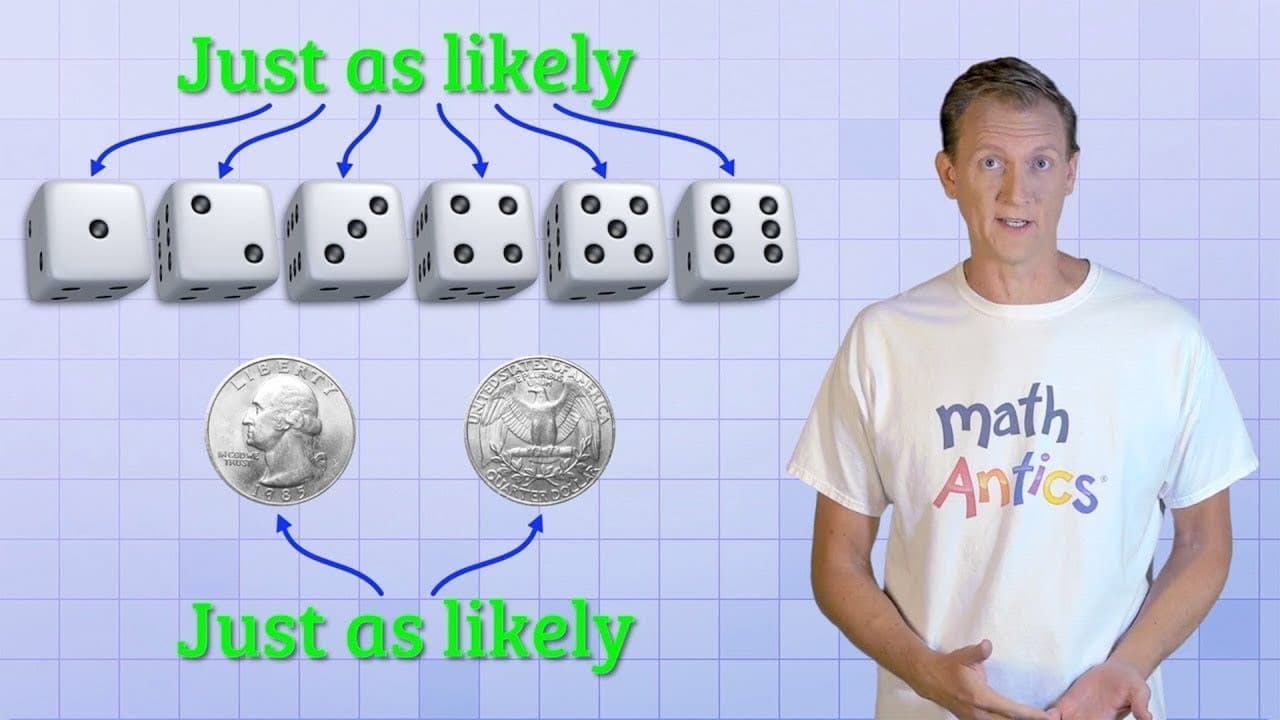

Probability Explained
Introduce sample space, outcomes, and the probability line.
Watch on YouTube
Finding Probability Example
Count favorable outcomes over total possible outcomes.
Watch on YouTube
Addition Rule for Probability
Combine probabilities of overlapping events.
Watch on YouTubePractice
For each problem: write your work in the box, type your answer, and check it. If you are stuck, reveal the solution one step at a time. Do not skip straight to the final answer.
Exercise 1
Try it yourselfA fair coin is flipped once. What is P(heads)?
Step-by-step solution
- 1One favorable outcome out of two equally likely: 1/2.
Exercise 2
Try it yourselfA bag has 4 green and 6 yellow marbles. Find P(green) if one marble is drawn at random.
Step-by-step solution
- 1Favorable = 4, total = 10.
- 2P(green) = 4/10 = 2/5.
Exercise 3
Try it yourselfA spinner has 5 equal sections numbered 1–5. Find P(even number).
Step-by-step solution
- 1Even outcomes: 2 and 4 → 2 favorable.
- 2P(even) = 2/5.
Exercise 4
Try it yourselfIn 40 trials, a nail lands point-up 10 times. What is the experimental probability?
Step-by-step solution
- 1Experimental P = successes ÷ trials = 10/40 = 1/4.
Exercise 5
Try it yourselfExpress 0.35 as a probability in simplest fractional form.
Step-by-step solution
- 10.35 = 35/100 = 7/20.
Quick check
Answer all questions. Retake the quiz until you feel confident before moving on.
Simple Probability
Question 1 of 4
A fair die is rolled. What is the probability of rolling a 4?