
The lesson
Read each section in order, work through every example on paper, then use the practice problems and quick check at the bottom.
Three formulas
- 1Cylinder: V = πr²h.
- 2Cone: V = (1/3)πr²h - a third of a cylinder with the same base and height.
- 3Sphere: V = (4/3)πr³.
Find the volume of a cylinder with radius 3 and height 5 (use π ≈ 3.14).
- 1V = πr²h = 3.14 × 3² × 5.
- 2= 3.14 × 9 × 5 = 141.3 cubic units.
Why this matters
Apply the three key volume formulas with π.
These ideas show up on homework, quizzes, and the next unit in this grade. Getting comfortable here saves time later when the problems stack more steps together.
Common mistakes to avoid
Rushing to the answer without writing steps. Clear work helps you catch mistakes and shows your reasoning.
Re-reading the question too quickly. Underline what you are solving for before you start calculating.
Key ideas from this lesson
- Three formulas
- Cylinder: V = πr²h.
- Cone: V = (1/3)πr²h - a third of a cylinder with the same base and height.
- Sphere: V = (4/3)πr³.
Video walkthroughs
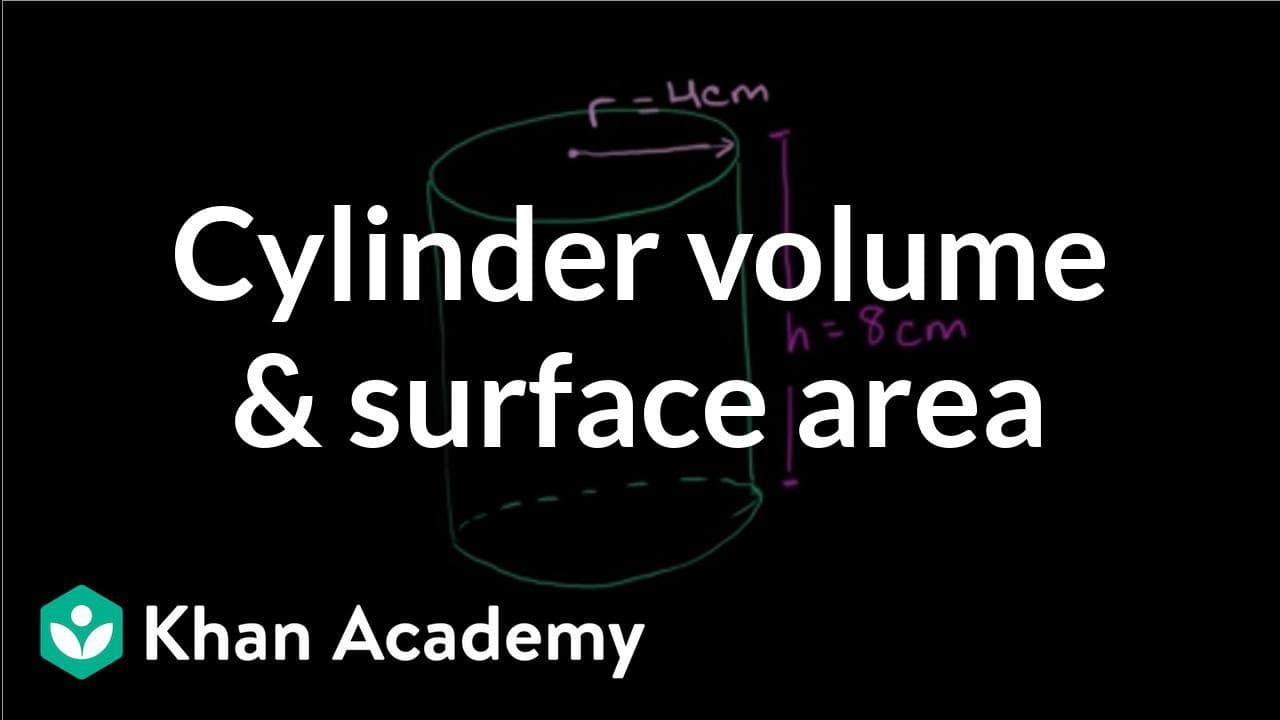
Cylinder Volume & Surface Area
Find the volume of a cylinder using V = πr²h.
Watch on YouTube


Practice
For each problem: write your work in the box, type your answer, and check it. If you are stuck, reveal the solution one step at a time. Do not skip straight to the final answer.
Exercise 1
Try it yourselfFind the volume of a cylinder with radius 2 cm and height 10 cm. Use π ≈ 3.14.
Step-by-step solution
- 1V = 3.14 × 2² × 10 = 3.14 × 4 × 10.
- 23.14 × 40 = 125.6.
- 3Volume ≈ 125.6 cm³.
Exercise 2
Try it yourselfA cone has radius 3 m and height 7 m. Find its volume. Use π ≈ 3.14.
Step-by-step solution
- 1V = (1/3) × 3.14 × 3² × 7.
- 2= (1/3) × 3.14 × 9 × 7 ≈ 65.94.
- 3Volume ≈ 65.94 m³.
Exercise 3
Try it yourselfA sphere has radius 6 in. Find its volume. Use π ≈ 3.14.
Step-by-step solution
- 1r³ = 6³ = 216.
- 2V = (4/3) × 3.14 × 216 ≈ 904.32.
- 3Volume ≈ 904.32 in³.
Exercise 4
Try it yourselfA cylinder and cone share the same radius 5 and height 12. How does the cone’s volume compare to the cylinder’s?
Step-by-step solution
- 1Cylinder: V = πr²h.
- 2Cone: V = (1/3)πr²h.
- 3The cone’s volume is one-third the cylinder’s.
Exercise 5
Try it yourselfA cylindrical water tank has diameter 8 ft and height 15 ft. How many cubic feet of water can it hold? Use π ≈ 3.14.
Step-by-step solution
- 1Radius r = 4 ft.
- 2V = 3.14 × 4² × 15 = 3.14 × 16 × 15 = 753.6.
- 3Capacity ≈ 753.6 ft³.
Quick check
Answer all questions. Retake the quiz until you feel confident before moving on.
Volume of Cylinders, Cones & Spheres
Question 1 of 4
Which formula gives the volume of a sphere?