
The lesson
Read each section in order, work through every example on paper, then use the practice problems and quick check at the bottom.
Exponents are repeated multiplication
2⁴ means 2 × 2 × 2 × 2 = 16. The base is 2 and the exponent is 4.
The key rules
- 1Product rule: same base, add exponents - x³ · x² = x⁵.
- 2Quotient rule: same base, subtract exponents - x⁵ ÷ x² = x³.
- 3Power rule: power of a power, multiply exponents - (x³)² = x⁶.
- 4Zero exponent: any nonzero base to the 0 power is 1.
Simplify x⁴ · x³ ÷ x².
- 1Multiply: x⁴ · x³ = x⁷ (add 4 + 3).
- 2Divide: x⁷ ÷ x² = x⁵ (subtract 7 - 2).
Why this matters
Use the product, quotient, and power rules to simplify expressions.
These ideas show up on homework, quizzes, and the next unit in this grade. Getting comfortable here saves time later when the problems stack more steps together.
Common mistakes to avoid
Doing different operations to each side of an equation. Whatever you add, subtract, multiply, or divide on one side, do to the other.
Combining unlike terms (like 3x and 4) as if they were the same kind of term.
Key ideas from this lesson
- Exponents are repeated multiplication
- The key rules
- Product rule: same base, add exponents - x³ · x² = x⁵.
- Quotient rule: same base, subtract exponents - x⁵ ÷ x² = x³.
- Power rule: power of a power, multiply exponents - (x³)² = x⁶.
- Zero exponent: any nonzero base to the 0 power is 1.
Video walkthroughs
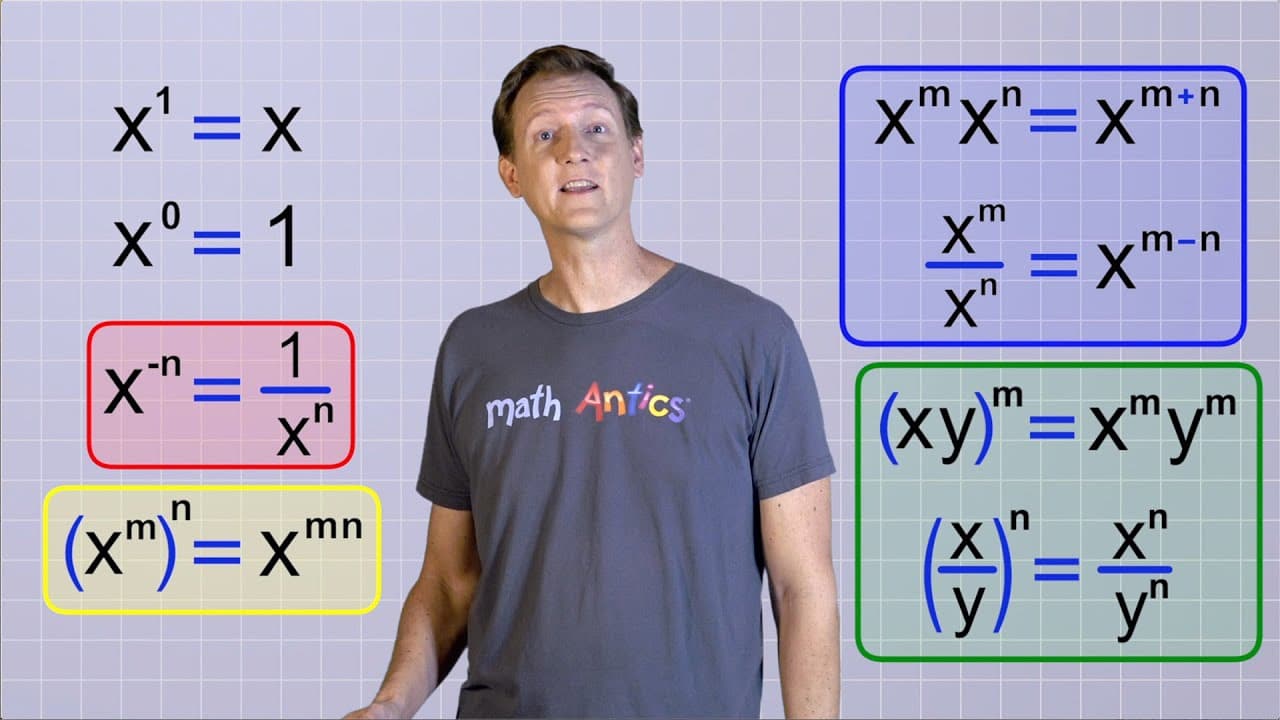

Intro to Exponents
Understand bases, exponents, and repeated multiplication.
Watch on YouTube
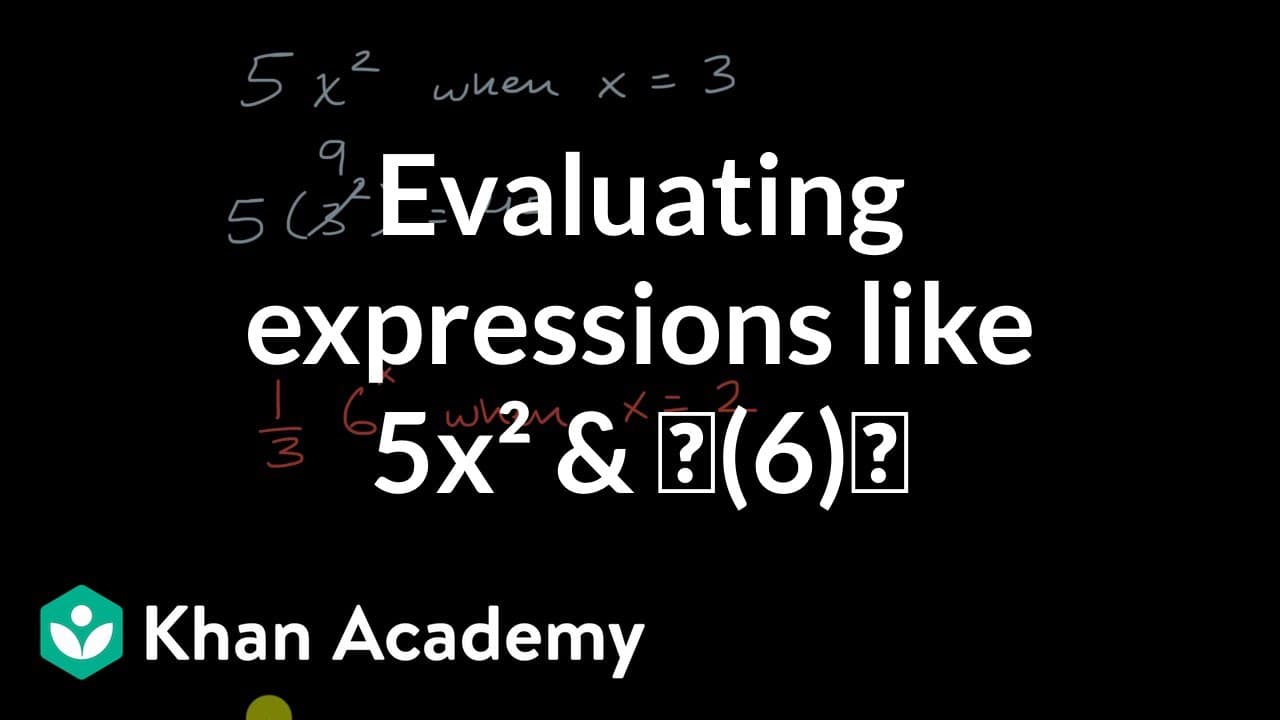
Evaluating Expressions with Exponents
Evaluate numeric expressions that use exponent rules.
Watch on YouTubePractice
For each problem: write your work in the box, type your answer, and check it. If you are stuck, reveal the solution one step at a time. Do not skip straight to the final answer.
Exercise 1
Try it yourselfSimplify: m⁴ · m².
Step-by-step solution
- 1Both factors have base m.
- 2Product rule: add exponents 4 + 2 = 6.
- 3Result: m⁶.
Exercise 2
Try it yourselfSimplify: (3²)³.
Step-by-step solution
- 1Apply the power rule: (3²)³ = 3^(2·3).
- 2Multiply exponents: 2 × 3 = 6.
- 3Result: 3⁶ = 729.
Exercise 3
Try it yourselfSimplify: x⁸ ÷ x³.
Step-by-step solution
- 1Same base x; use the quotient rule.
- 2Subtract exponents: 8 − 3 = 5.
- 3Result: x⁵.
Exercise 4
Try it yourselfSimplify: 2⁻³.
Step-by-step solution
- 1Definition: 2⁻³ = 1 / 2³.
- 2Compute 2³ = 8.
- 3Result: 1/8.
Exercise 5
Try it yourselfSimplify: (2x³)².
Step-by-step solution
- 1Power of a product: (2x³)² = 2² · (x³)².
- 22² = 4 and (x³)² = x⁶.
- 3Result: 4x⁶.
Quick check
Answer all questions. Retake the quiz until you feel confident before moving on.
Properties of Exponents
Question 1 of 5
Simplify: x⁵ · x³.