
The lesson
Read each section in order, work through every example on paper, then use the practice problems and quick check at the bottom.
The distributive property
To remove parentheses, multiply the number outside by every term inside. For example, 3(x + 4) = 3·x + 3·4 = 3x + 12.
Combining like terms
Like terms have the exact same variable part. You can add or subtract their coefficients (the numbers in front). Constants combine with constants.
Simplify 2x + 4 + 3x − 1.
- 1Group like terms: (2x + 3x) + (4 − 1).
- 2Combine: 5x + 3.
Why this matters
Spread the number outside the parentheses, then combine matching terms.
These ideas show up on homework, quizzes, and the next unit in this grade. Getting comfortable here saves time later when the problems stack more steps together.
Common mistakes to avoid
Rushing to the answer without writing steps. Clear work helps you catch mistakes and shows your reasoning.
Re-reading the question too quickly. Underline what you are solving for before you start calculating.
Key ideas from this lesson
- The distributive property
- Combining like terms
Video walkthroughs

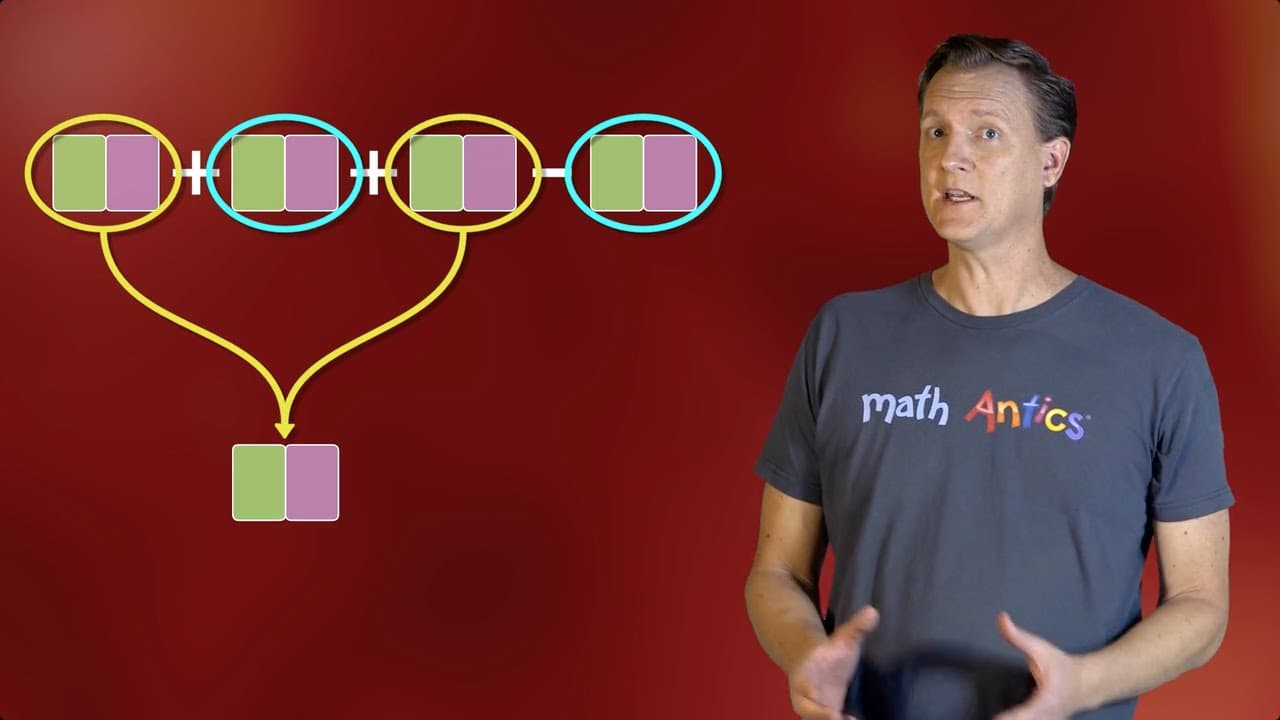
Combining Like Terms
Add or subtract terms that share the same variable part.
Watch on YouTube
Writing Expressions with Variables
Translate word phrases into algebraic expressions.
Watch on YouTube
Evaluating Expressions with Two Variables
Evaluate simplified expressions after combining like terms.
Watch on YouTubePractice
For each problem: write your work in the box, type your answer, and check it. If you are stuck, reveal the solution one step at a time. Do not skip straight to the final answer.
Exercise 1
Try it yourselfUse the distributive property to expand: 5(y + 2).
Step-by-step solution
- 1Multiply 5 by each term inside: 5·y + 5·2.
- 2Result: 5y + 10.
Exercise 2
Try it yourselfSimplify: 4x + 7 + 2x.
Step-by-step solution
- 1Combine like terms with x: 4x + 2x = 6x.
- 2Keep the constant: 6x + 7.
Exercise 3
Try it yourselfSimplify: 3(2m − 4) + m.
Step-by-step solution
- 1Distribute: 6m − 12 + m.
- 2Combine like terms: 7m − 12.
Exercise 4
Try it yourselfSimplify: 8a − 3 + 2a + 9 − a.
Step-by-step solution
- 1Combine a terms: 8a + 2a − a = 9a.
- 2Combine constants: −3 + 9 = 6.
- 3Result: 9a + 6.
Exercise 5
Try it yourselfSimplify: 2(3x − 5) − 4(x + 1).
Step-by-step solution
- 1Distribute: 6x − 10 − 4x − 4.
- 2Combine like terms: 2x − 14.
Quick check
Answer all questions. Retake the quiz until you feel confident before moving on.
Distributive Property & Like Terms
Question 1 of 5
Which expression is equivalent to 3(x + 4)?